Maths
Curriculum
Maths
Maths Curriculum Intent, Implementation and Impact Statement
Intent
The intention of our Maths curriculum at Hannah Ball Academy is for children to be excited about Maths. Our key objective is that children gain a solid and deep understanding of mathematical concepts – recognising the power of thinking, not just doing, which in turn will allow them to see patterns and make connections. We provide a Mastery for All curriculum, ensuring that the vast majority of pupils move through the curriculum at the same pace, focusing on depth of understanding rather than breadth of coverage.
We believe that all children can be successful mathematicians with the right mind-set. Research has shown that knowledge is not fixed, and we therefore embed a growth mind-set approach into all our children – through hard work, practice and a willingness to see mistakes as part of their journey – they can succeed. Our curriculum is designed to build both substantive knowledge (facts and procedures) and disciplinary knowledge (the ability to reason and problem solve), ensuring children understand the how and the why. All children are encouraged to be brave and push boundaries, deepening their understanding further. We are committed to delivering mathematics in innovative ways that link to real-life experiences and, where possible, to prepare our children for the future. We aim to see our pupils leave at the end of Year 6 with the skills and confidence to solve a range of mathematical problems that require fluency with numbers and reasoning.
Implementation
Teachers promote children’s enjoyment of maths and provide opportunities for them to build a conceptual understanding before applying their knowledge to everyday problems and challenges. We ensure that challenge is provided for all children, whatever their understanding level is.
EYFS: In our Early Years, we use White Rose and the NCETM Mastering Number programme. This provides our youngest learners with a firm foundation in number sense, focusing on subitising, composition of number, and cardinality. This ensures children are ready to progress as they transition into Key Stage 1.
Key Stage 1 and 2: To ensure consistent coverage, teachers follow the White Rose scheme of learning to support their planning, broken down into small steps to ensure manageable cognitive load.
Upper Key Stage 2: In Upper Key Stage 2, we enhance our mastery delivery through the use of Magma Maths. This digital platform allows pupils to record their hand-drawn mathematical thinking, providing teachers with an immediate, live overview of the entire class's progress. This enables teachers to identify and address misconceptions the moment they occur, ensuring that no child’s misunderstanding is carried forward to the next lesson.
Inclusion and SEND
We have high ambitions for all learners. For pupils with SEND, we follow a Scaffold, Not Simplify approach. This includes:
- Pre-teaching of key vocabulary and concepts.
- Micro-stepping the White Rose Small Steps to prevent frustration.
- Extended Concrete, Pictorial, Abstract phases, allowing for longer use of concrete manipulatives.
- Reducing cognitive load through pre-drawn grids, dual-coding, and the use of Magma Math’s adaptive settings to provide instant feedback for lower-attaining pupils.
High-quality resources are used in conjunction with White Rose, such as Power Maths, Third Space Learning, Talk it, Solve it and NCETM to support, stretch and challenge all children. In addition, the school’s calculation policy is used to ensure a coherent approach to teaching the operations across our school. In addition to the main maths lesson, daily Flashback4s are used to revisit prior learning.
Every lesson is divided into sections that involve plenty of retrieval, discovery, sharing, thinking together, practice and reflection. Lessons use a Concrete, Pictorial and Abstract (CPA) approach:
Concrete Step: The doing stage. Pupils use concrete objects (Numicon, Base 10, Rekenreks) to model problems.

Pictorial Step: The seeing stage. Visual representations like bar models or part-whole models are used.

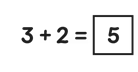
Abstract Step: The symbolic stage, using only numbers, notation, and symbols (+, –, x, /).
Teachers use precise questioning in class to test conceptual and procedural knowledge and assess children regularly to identify those requiring interventions. Children’s explanations and their proficiency in articulating mathematical reasoning are supported through the use of stem sentences provided by the teacher.
Impact
Children are developing skills in being able to reason verbally, pictorially and in written form. We measure the impact of our curriculum through:
- Pupil Voice: Children can speak confidently about their learning using correct vocabulary.
- Independence: Pupils can select their own manipulatives or methods to solve problems.
- Evidence of Learning: Through both traditional book-looks and the digital portfolios provided by Magma Math, which track individual progress and conceptual growth over time.
- Assessment: The use of White Rose end-of-block assessments, PiXL and DfE/White Rose Ready-to-Progress criteria to ensure children are secure before moving on.
As a result of our Maths teaching at Hannah Ball Academy, we expect that:
- Our pupils will be engaged and challenged and are confident to use different mathematical concepts.
- Pupils will become fluent in the fundamentals of mathematics and show high levels of resilience when faced with non-routine problems.
- Pupils will be able to reason mathematically by following a line of enquiry, developing an argument, justifying or proving reasoning using mathematical language.
- Learning is tracked and monitored to ensure all children make good progress and immediate interventions are put in place where progress is not being made.
- Pupils from all backgrounds and abilities achieve well in mathematics, with SEND pupils making strong progress from their individual starting points.
- Learning Mathematics will ensure children understand how mathematics is essential to everyday life and financial literacy.
- Children can recall facts and methods taught in previous terms and years due to regular retrieval practice.